

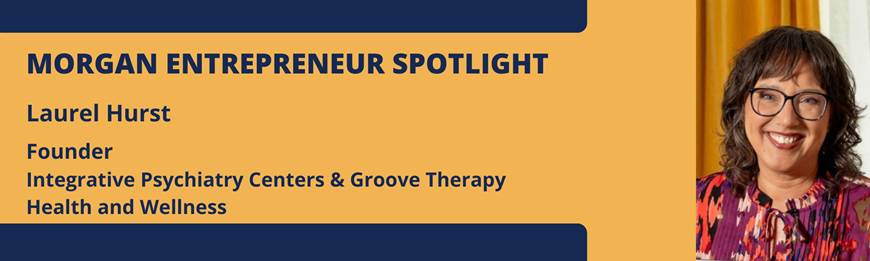
Welcome to "Morgan Entrepreneur Spotlight," our monthly-ish showcase where we shine a light on Northeast Ohio's entrepreneurial superstars. Each feature delves into the journeys of individuals who have participated in our programs and are harnessing their learnings to fuel impressive growth and innovation.
Laurel Hurst is the founder of Integrative Psychiatry Centers and Groove Therapy. She has participated in a number of Morgan Foundation-supported growth programs, including the LaunchNET program at Kent State University and the Morgan Startup Grant Program.
About Your Business
Please tell us a little about your business.
“I am an ethnomusicologist-turned-psychiatric nurse practitioner who helps people restore mental wellness through GROOVE THERAPY™. By engaging with groove and drumming together, people reorganize their nervous systems, communication, and relationships - relieving stress that is both physical and emotional. GROOVE THERAPY™ is a non-force approach to mental wellness rather than mental disorder, and because everyone can move or be moved to groove, it is safe, effective across all ages, and compatible with any other mental health intervention. GROOVE THERAPY™ is unique because it is a self-motivating force for flourishing mental health.”
Tell us a bit about the growth or entrepreneurship programs in which you’ve participated.
“My entrepreneurship journey began with the Ice House Entrepreneurship Program led by Ace Epps of Akron, where I learned to see problems and their solutions as the foundation of business success.
Since 2017, Kent State University's LaunchNet has supported my growth, and from 2020 to 2022 I received multiple Innovation Studio grants from The Ohio State University to develop the GROOVE SESSIONS® and GROOVE THERAPY™ models.
Most recently, a 2025 grant I received via the Morgan Startup Grant program furthered that momentum.”
How have these programs influenced your business or leadership approach? What were your key takeaways?
“The relationships I built through the Morgan Foundation Rooted & Rising program reinforced my belief that net worth is built through network. Walking alongside local business owners learning to understand and serve their clients reminded me how deeply human the work of building a business truly is — and led me to lean into my humanities background as a foundation for my business and leadership approach.”
Tell us about any growth, milestones, or key wins you’ve experienced since participating in a Foundation-supported program or other growth program.
“During the Morgan Startup Grant period, I launched YourPsychCenter.com, brought GrooveForHealth.com up to date, and filed a key intellectual property application for a registered trademark. Completing those core pieces of my business suite propelled me to build out offers, expand outreach, and meet potential clients in enrollment/sales conversations. I'm excited by how the presence of my business in the holistic health space is getting noticed.”
What has been your biggest challenge in growing your business, and how did you navigate it?
“Technology has been my most relentless challenge in growing a pre-revenue business. Rather than pushing through technical barriers alone, I invested early in support. A small, trusted team of Fiverr professionals understands my vision and executes it quickly, keeping me focused on strategy and creative development. A virtual operations assistant, working about ten hours a week, handles fact-finding and follow-up, ensuring that repetitive tasks don't fall through the cracks. Together, this support lets me lead from my strengths rather than stall on avoidable friction.”
What are one to three goals you hope to achieve in the next twelve months?
“#1 Establish a physical community hub for neurorestorative care.
Identify and operationalize a brick-and-mortar location that supports both clinical services and community-based neurorestorative programs, including space for group rhythm work, psychotherapy, and a small number of private clinician offices.
#2 Launch a focused neurorestoration intensive for healthcare leaders.
Adapt an existing 90-day virtual care model into a four-day, in person immersive format that allows healthcare workers to step out of chronic stress patterns and engage in evidence-informed practices that restore emotional regulation and functional capacity.
#3 Expand equitable access to care.
Expand digital resources that allow individuals living with chronic stress to access NeuroRestorative Community regardless of location or ability to attend in person.”
Insights & Impact
How do you define success — for yourself or your business?
“I believe human beings are designed to move toward their innate purpose, embodying the beauty of a benevolent Creator. When I and my business align with that design, I consider myself successful.”
What motivates you to keep going when things get tough?
“The beliefs that all people deserve to flourish and that human-to-fellow-human understanding makes for a good life.”
Who has been an important mentor, partner, or supporter in your journey?
“My spouse is the singular reason I believed I could succeed in graduate school in the middle of raising a large and active family, and he became the prime motivator in the decision to build a business. Without his direct encouragement, I would not have had the freedom of mind or circumstances to pursue such daunting challenges. I also credit Dr. Karen Moss for showing me—in the context of leading her research laboratory team—what emotional regulation and radical responsibility look like.”
How does your business contribute to your community or industry?
“People who have never believed remission from mental health disorder is possible find help in my clinic. The ripple effects of their wellness in families, workplaces, and the broader community are immeasurable.
The clinic is also devoted to mentoring other clinic owners. I believe the Groove Therapy™ therapeutic and Shared Medical Appointment business models are effective and profitable ways to increase clinician wellbeing, so I want other clinicians to know how to give care in these ways. Integrative Psychiatry Centers also gives back to local nonprofits that support wellbeing through music-making including Trust Drum Circles and BLOC Ministries.”
What advice would you offer to entrepreneurs just getting started?
“Solve a problem that is a "must solve" issue in the mind of someone who can and will pay to have it solved and solve the problem in a business you actually want to run (or sell), at the end of the day.”
Personal Reflections
What role does innovation or creativity play in your business?
“Innovation and creativity are balanced with evidence in my business. Only solutions that are considered safe and effective can be used in clinical healthcare practice, so new ideas need to come to market as science-backed solutions.”
What book, quote, or resource has most inspired you?
“Let Prayer Change Your Life by Becky Tirabassi did change my life. The core practice it teaches is encountering who God is and what God does through the Psalms—and being transformed, through admiration and gratitude rather than shame and despair, into the likeness of God. The potential of this practice feels infinite.”
What legacy or long-term impact do you hope to build through your entrepreneurial work?
“I hope that groove-based music making—melorhythm—becomes as ubiquitous to mental wellness as sleep, nutrition, and exercise.”
To learn more about Morgan Foundation sponsored programs and opportunities for startup ventures, contact Angela Evans.
If you have participated in Morgan Foundation sponsored programs and are interested in being featured in the Spotlight, contact Gina Dotson.